
Conflict between cats living together is common, frequently invisible, and one of the leading reasons cats are rehomed — often the wrong cat.
The reason it goes unnoticed is that cats rarely fight openly. They compete by controlling space and access, and it looks like nothing at all.
Play or fighting?
Owners often panic at rough play and miss genuine conflict entirely. The distinctions are reliable once you know them.
| Play | Conflict | |
|---|---|---|
| Noise | Mostly silent | Hissing, growling, yowling |
| Ears | Forward | Flattened back |
| Claws | Usually sheathed | Out |
| Turn-taking | Roles swap, both chase | One always pursues |
| Afterwards | Both relaxed, may groom | One hides or avoids |
| Fur | Flat | Puffed, arched back |
| Injuries | None | Scratches, abscesses |
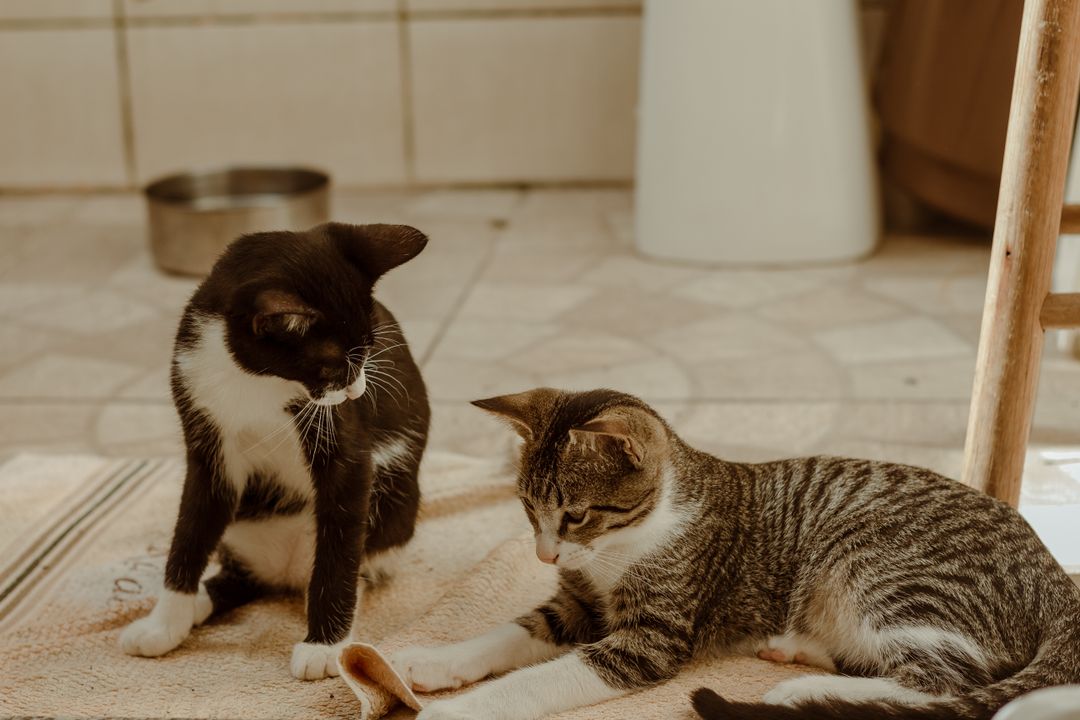
Turn-taking is the most useful single test. In play the roles reverse; in conflict one cat is always the aggressor and the other always retreats.
The conflict you cannot hear
This is the important part. Most household cat conflict involves no fighting whatsoever.
Cats compete by controlling access — sitting in doorways, staring, occupying the top of the stairs, positioning themselves between another cat and the litter box.
- One cat blocking a corridor or doorway.
- Prolonged staring, which is genuinely threatening between cats.
- One cat waiting until another leaves before eating.
- A cat that stops using an upstairs litter box.
- A cat spending most of its time in one room.
- Reduced play, grooming or interaction in the less confident cat.
The victim of this is usually the quiet cat that owners describe as “just shy” or “always been independent”. It is frequently under sustained pressure.
Jackson Galaxy publishes extensive practical material on multi-cat household dynamics.
Why it starts
| Trigger | Notes |
|---|---|
| New cat introduced too quickly | The commonest cause by far |
| Insufficient resources | Competition over boxes, food, resting spots |
| Social maturity, 2–4 years | Previously fine cats can begin competing |
| A cat returning from the vet | Smells wrong, treated as an intruder |
| Outside cats visible | Redirected onto a housemate |
| Pain or illness in one cat | Reduced tolerance |
| Too many cats for the space | Density itself is a stressor |
The vet-return one surprises people and is easily fixed — our carrier training guide covers the scent-swap that resolves it.
Pain is worth checking properly. A cat that has become intolerant may simply hurt. Our guide to arthritis in cats covers the commonest hidden cause in older cats.
Fix the resources first
A large share of conflict resolves with environmental change alone, and it is far easier than behavioural work.
- One litter box per cat plus one, in separate rooms — not lined up together.
- Multiple feeding stations, out of sight of each other.
- Several water sources around the house.
- Abundant vertical space so cats can pass without meeting.
- Multiple hiding places and high resting spots per cat.
- At least two routes in and out of key rooms, so nothing can be blocked.
Vertical space does the heaviest lifting. Cats resolve most tension by using height rather than confrontation, and a home with shelves and trees has far more usable territory than its floor area suggests.
Our guide to multi-cat households covers capacity honestly.
Reintroduction
Where conflict is established, separating and reintroducing from scratch is usually necessary. It is the same staged process used for a new cat.
- Separate completely — different rooms, no contact.
- Swap bedding and rub a cloth on each cat, transferring scent.
- Feed on either side of a closed door, moving bowls closer over days.
- Brief visual contact through a barrier or cracked door.
- Short supervised sessions, ending while calm.
- Gradually extend, and only then allow unsupervised access.
This takes weeks. Rushing it is what caused the problem in most cases, and rushing the repair repeats it.
Our guide to introducing a new cat to resident pets covers the same method in detail.
Breaking up a fight safely
Never put hands between fighting cats. Redirected bites cause serious injuries and cat bites carry real infection risk.
Make a sudden loud noise, throw a cushion nearby, or drop a towel or blanket over one cat and lift it away. Then separate them completely for several hours.
An aroused cat stays aroused for a long time. Attempting to reintroduce them after twenty minutes usually restarts the fight.
When to involve a vet
Some situations need professional help rather than another month of environmental tweaking.
- Injuries, particularly bite wounds, which abscess readily.
- A cat that has stopped eating or using the litter box.
- Sudden aggression in a previously peaceful cat — check for pain.
- Conflict that has not improved after several weeks of proper reintroduction.
- Any cat living in constant hiding.
Vets can also advise on pheromone products and, in some cases, medication to lower baseline anxiety while behavioural work continues.
Rehoming one cat is occasionally the kindest answer, particularly where one cat is genuinely miserable. That is a legitimate outcome rather than a failure — our guide to rehoming a cat in Fresno covers doing it well.

How many cats is too many
Density itself is a stressor, and there is a point at which no amount of resource provision resolves conflict.
There is no fixed number — it depends on space, layout, vertical territory and the individual cats. Some households run five peacefully; others cannot manage two.
- Watch for chronic hiding in any individual.
- Watch for one cat controlling access to key resources.
- Watch for stress-related illness such as cystitis.
- Watch for over-grooming or appetite changes.
- Be honest if adding another cat is the trigger.
Our guide to multi-cat households covers capacity honestly, and cat urinary problems covers the stress-linked condition that most often results.
Frequently Asked Questions
How do I know if my cats are playing or fighting?
Watch for turn-taking. In play the roles reverse and both chase, ears stay forward and it is mostly silent. In conflict one cat always pursues, ears flatten, and there is hissing or growling.
Can cats fight without making any noise?
Yes, and most household conflict is silent. Cats compete by blocking doorways, staring, and controlling access to food and litter boxes. There may be no fighting while one cat is under real pressure.
Why did my cats suddenly start fighting?
Common triggers include a cat returning from the vet smelling wrong, social maturity between two and four years, an outside cat visible through a window, or pain in one of the cats.
How do I break up a cat fight?
Never use your hands — redirected bites cause serious injuries. Make a sudden loud noise, throw a cushion nearby, or drop a towel over one cat. Then separate them for several hours.
What resources do multi-cat households need?
One litter box per cat plus one in separate rooms, multiple feeding stations out of sight of each other, several water sources, abundant vertical space, and two routes in and out of key rooms.
How long does reintroducing two cats take?
Weeks, following the same staged process used for a new cat — full separation, scent swapping, feeding either side of a door, then brief supervised contact. Rushing it restarts the conflict.