

There’s no single legal cap on how many cats you can own, but there is a very real point where more cats stops meaning more happiness — for the cats or for you. Here’s what the actual guidance says, and how to tell if your household has reached its limit.
The General Guidance
Veterinarians and veterinary behaviorists commonly recommend no more than four to five cats in a single household, with six often cited as a hard cutoff. Beyond that point, medical and behavioral problems become noticeably more common — not because cats are inherently incompatible in groups, but because space, resources, and individual attention all get stretched thinner.
Why Two or Three Is Often the Real Sweet Spot
Many experts specifically point to two to three cats as ideal for most households — enough companionship for the cats without overwhelming your space, budget, or your ability to give each one meaningful individual attention. The right number ultimately depends on your specific environment and how much time you can realistically devote to each cat.
The Litter Box Math
The standard rule is n+1 litter boxes — as many boxes as you have cats, plus one extra. That means a two-cat household needs three boxes, and a four-cat household needs five, ideally spread across different locations rather than lined up in a single spot.

| Number of Cats | Recommended Litter Boxes |
|---|---|
| 1 | 2 |
| 2 | 3 |
| 3 | 4 |
| 4 | 5 |
Warning Signs You’ve Hit Your Limit
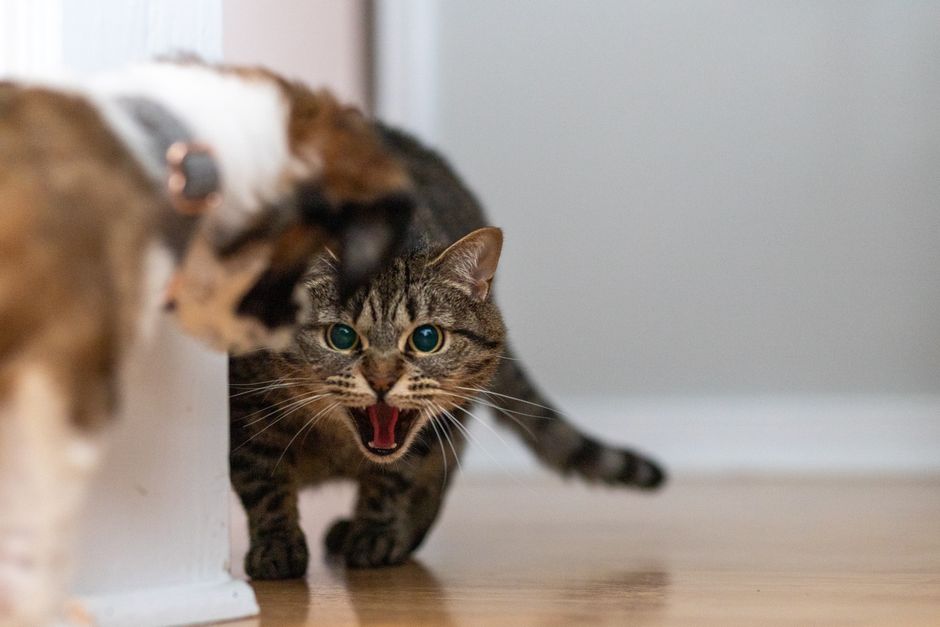
- Constant hissing, swatting, chasing, or full-on fights between cats
- Litter box avoidance, spraying, or boxes that are constantly full faster than they can be cleaned
- Noticeable weight loss, hiding, or stress-related grooming in one or more cats
- You genuinely can’t remember the last time you gave a specific cat one-on-one attention
Resources Beyond Just Litter Boxes
- Multiple, separated food and water stations — cats often prefer not to eat right next to another cat
- Vertical space (cat trees, shelves) so cats can establish separate territories without needing more floor space
- Enough hiding spots that every cat has somewhere to retreat when it wants to be alone

If You’re Considering Adding Another Cat
Before adopting an additional cat, honestly assess your current setup against the signs above. If you’re already seeing tension or litter box issues with your current cats, adding another is more likely to make existing problems worse rather than solve loneliness. See our guide to introducing a new cat to resident pets if you’ve decided the timing is right.

The Budget Side of the Equation
Beyond behavior and space, the financial math of a multi-cat household matters just as much. Each additional cat adds a full set of recurring costs — food, litter, routine vet visits — that scale roughly linearly rather than getting cheaper per cat the way some bulk purchases might suggest. A household that’s financially comfortable with two cats isn’t automatically comfortable with four, especially once an emergency vet bill for even one cat enters the picture.
Why Individual Attention Actually Matters
Cats are often assumed to be more independent than dogs, but that doesn’t mean they don’t need real one-on-one engagement — play sessions, grooming, and simple attention from their owner. In a household with too many cats, it becomes easy for a quieter, less demanding cat to get consistently overlooked in favor of a more vocal or assertive one, even without anyone intending for that to happen. If you can’t remember the last time you gave a specific cat focused, individual attention, that’s a meaningful sign worth taking seriously.
When a Multi-Cat Household Works Well
None of this means multiple cats can’t work beautifully in the right household — many homes with three or four cats run smoothly, with each cat well-adjusted and getting what it needs. The difference usually comes down to deliberate resource planning (litter boxes, feeding stations, vertical space) done in advance, rather than simply adding cats and hoping the household sorts itself out organically.
When Rescuing Turns Into Hoarding
There’s an important, sometimes uncomfortable distinction between a well-managed multi-cat household and a hoarding situation, and it’s not simply about the number of cats involved. Animal hoarding is characterized by an inability to recognize that animals are suffering — overcrowding, illness, malnutrition, and unsanitary conditions that the owner genuinely doesn’t perceive as a problem, often despite good intentions and genuine love for the animals. If you or someone you know has gradually taken in more cats than can realistically be cared for and finds it difficult to acknowledge the resulting conditions, reaching out to a local shelter or animal welfare organization for support is a compassionate step, not an admission of failure.
A Practical Self-Check
A useful gut-check before adding another cat: can you currently name each cat’s personality, favorite spot, and any health quirks off the top of your head? Owners who can answer this easily for every cat in the home are generally still giving each one real individual attention. If you find yourself unable to answer for one or more cats, that’s a meaningful sign worth taking seriously before adding another to the mix.
The Bottom Line
There’s no single magic number that’s right for every household — what matters is whether each cat currently in your home has enough space, resources, and individual attention to thrive, and whether adding another cat would genuinely improve that picture or simply stretch it thinner. Being honest with yourself about that answer, rather than deciding purely based on how many cats feel manageable at a glance, is the real test worth applying before bringing home cat number three, four, or five.
Frequently Asked Questions
Is there an official number of cats considered “too many”?
Not a single official number, but veterinarians and veterinary behaviorists commonly recommend no more than four to five cats per household, with six generally seen as a hard cutoff before medical and behavioral issues become much more likely.
How many litter boxes do I actually need?
The standard guideline is one litter box per cat, plus one extra — so a three-cat household should have four litter boxes, spread across different locations rather than clustered together.
What are the clearest signs a household has too many cats?
Constant hissing, swatting, chasing, or outright fights, along with litter box avoidance or spraying, and boxes that are constantly full faster than they can be cleaned.
Is two or three cats actually ideal, or just safer than five or six?
Many experts specifically point to two or three cats as a genuine sweet spot — enough for companionship without overwhelming your space, budget, or ability to give each cat real individual attention.
Thinking About Adding a Cat?
Browse our adoptable cats, or reach out with questions about whether now is the right time.