
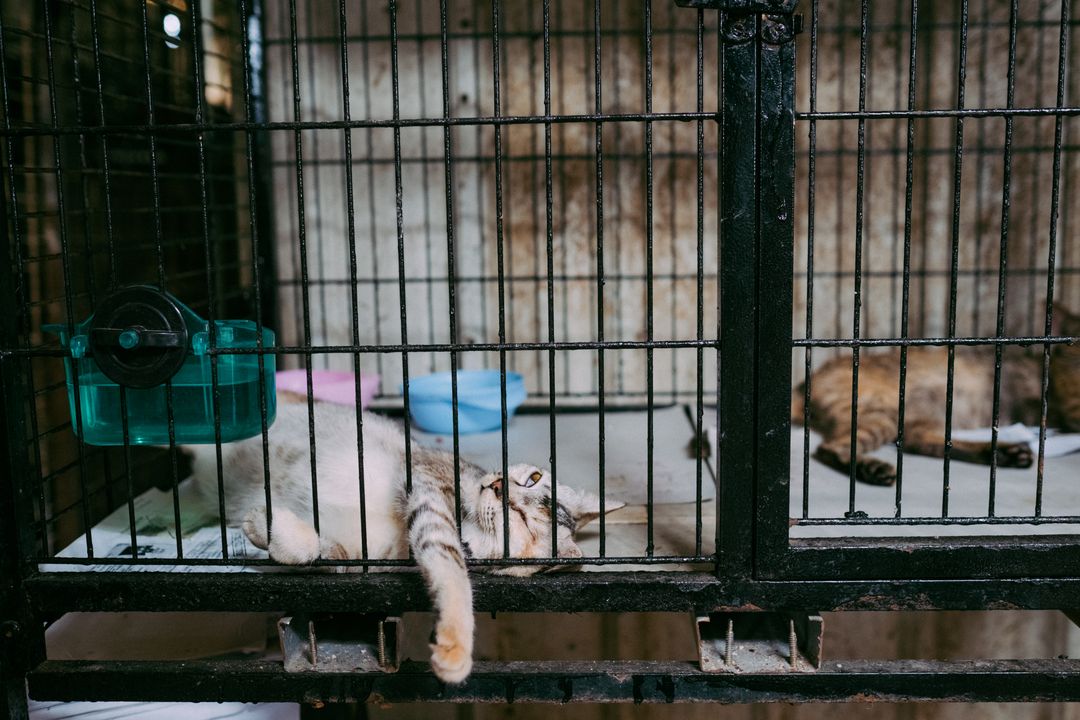
Businesses regularly offer to host adoption events, and rescues regularly decline — not because the offer is unwelcome, but because most venues are unsuitable in ways the owner has not considered.
Hosted well, these events place cats and bring people through your door. Hosted badly, they stress animals and produce nothing.
What makes a venue suitable
| Requirement | Why | Common problem |
|---|---|---|
| Indoor, climate controlled | Heat kills; cats cannot regulate in a hot space | Outdoor or unshaded venues |
| Away from entrance doors | Escape risk and constant draughts | Cats placed by the front door |
| Quiet, low footfall corner | Noise and crowds distress cats | Placed in the busiest aisle |
| No resident dogs on site | Dogs terrify cats at close quarters | Pet stores with dog traffic |
| Space for enclosures and volunteers | Cats need room; volunteers need to work | A single small table offered |
| Access to a sink and toilet | Hygiene and long shifts | Overlooked entirely |
| Somewhere private for paperwork | Adoption conversations are personal | Conducted in an aisle |
The door placement is the most common mistake. It feels like the best spot for visibility and it is the worst spot for a cat — draughty, loud and an escape risk every time it opens.
Who does what
Clarity here prevents most problems on the day.
The rescue handles: transport, enclosures, all cat handling, applications, screening, adoption decisions, insurance for its own activity, and taking the animals home.
The venue provides: the space, power if needed, access to water, promotion, and staff who understand the ground rules.
The venue should never handle cats, approve an adoption, or take payment on the rescue’s behalf unless that has been explicitly arranged.
Animal Sheltering publishes operational guidance on off-site adoption programmes.
Animal welfare is the limiting factor
It is easy to think of this as a retail event. From the cat’s point of view it is several hours in a strange, loud place surrounded by strangers.
- Secure enclosures with a covered hiding space in each — not open pens.
- A strict limit on event duration; a few hours, not a full trading day.
- Water available and a litter tray in each enclosure.
- A rule that visitors do not reach into enclosures — volunteers handle cats.
- A quiet retreat space where a struggling cat can be moved out of sight.
- Volunteers empowered to end the event early if the cats are not coping.

That last point is worth agreeing explicitly in advance. A venue that treats an early finish as a breach of agreement makes the rescue’s welfare decision harder than it should be.
Our guide to how adoption events work covers the adopter’s side.
Central Valley heat
Between roughly May and September, an event is only viable in a properly air-conditioned space.
Cats cannot be transported or held in heat, and the drive to and from the venue matters as much as the venue itself. Morning events are safer than afternoon ones.
Our guide to keeping cats safe through Central Valley summers covers the risk.
Promotion is where venues add real value
This is the part a business does better than a small rescue, and it is what turns a quiet event into a productive one.
- Announce it a week or two ahead, not the day before.
- Name specific cats with photographs rather than advertising “an adoption event”.
- Put signage in the window in advance.
- Email your customer list if you have one.
- Tell staff so they can mention it to customers all week.
- Post afterwards about the cats that were adopted.

Naming individual cats consistently outperforms generic promotion. Our guide to writing adoption profiles that work covers why specificity converts.
Set expectations about outcomes
A successful event might place two cats. Some place none and still produce applications, fosters and donations weeks later.
Judging it purely on same-day adoptions leads businesses to conclude it did not work when it did.
Ask the rescue afterwards what came of it. Applications submitted later are frequently the larger part of the result.
Making it a repeat arrangement
One-off events are useful. A monthly or quarterly slot is considerably more so, because rescues can plan around it.
| Frequency | Value to the rescue |
|---|---|
| One-off | Useful, but hard to plan around |
| Quarterly | Good — predictable and manageable |
| Monthly | Very good if volunteer capacity allows |
| Permanent in-store space | Highest, but a much bigger commitment |
A permanent in-store adoption space is a serious undertaking involving daily care, and should only be discussed with a rescue that has the volunteer capacity for it.
What the business gets
Worth being straightforward about, since this is usually a genuine two-way arrangement.
Footfall, goodwill, social media content, and association with local work people care about. Businesses that host regularly report it as one of their better community activities.
If you would like to host, approach a rescue with specifics: your space, dimensions, climate control, footfall, dates and what you can promote. A concrete offer gets a far better response than a general one.
Our contact page is the place to start, and our guide to running a supply drive covers a lower-commitment alternative.
Practical things to agree in writing
A short written arrangement prevents almost every dispute that arises on the day, and it takes ten minutes.
- Date, arrival time, setup window and finish time.
- Exactly which area of the premises is being used.
- Who provides tables, power and access to water.
- That the rescue may end early on welfare grounds without penalty.
- Who handles promotion, and what each party will post.
- Confirmation that the rescue carries its own insurance for its activity.
Neither side needs a formal contract. An email confirming those six points is sufficient and means nobody is relying on a remembered conversation.
Our guide to running a pet supply drive covers a lower-commitment way to work with a rescue if a full event is too much.
Frequently Asked Questions
What does a venue need to host a cat adoption event?
An indoor climate-controlled space away from entrance doors, a quiet low-footfall corner, no resident dogs, room for enclosures and volunteers, and access to a sink and somewhere private for paperwork.
Where should cats be placed inside a venue?
Not by the front door, which is the commonest mistake. It is draughty, loud and an escape risk every time the door opens. A quiet corner away from the entrance is far better.
Who handles the cats at an adoption event?
The rescue, always. Venue staff should not handle cats, approve adoptions or take payment unless explicitly arranged. Visitors should not reach into enclosures either.
How long should an adoption event run?
A few hours rather than a full trading day. From the cat’s point of view it is time in a strange, loud environment, and volunteers should be free to end early if the cats are not coping.
Can adoption events run in Central Valley summer?
Only in properly air-conditioned spaces, and morning events are safer than afternoon. Transport to and from the venue matters as much as the venue itself in extreme heat.
How many cats get adopted at a typical event?
Often only one or two, and some place none while still generating applications, fosters and donations weeks later. Judging purely on same-day adoptions understates the result.